The 9Hotel Bastille-Lyon, a hotel near Place de la Nation
Place de la Nation
Location & Comfort
9Hotel Bastille-Lyon: Your Ideal Hotel for Visiting Place de la Nation
Located at 23 Rue de Lyon, the 9Hotel Bastille-Lyon offers a convenient and welcoming base for exploring Place de la Nation while enjoying the charm of the 12th arrondissement.
It takes about 32 minutes to walk from the hotel to Place de la Nation—a pleasant stroll that takes you through some of the most characteristic neighborhoods of eastern Paris. For a faster trip, Metro Line 1 connects Gare de Lyon station directly to Nation station in just 13 minutes, an ideal option before a night out or in case of uncertain weather.
When staying at the hotel, you’re just a 10-minute walk from the Gare de Lyon and Gare d’Austerlitz train stations. The neighborhood is perfectly connected via Metro lines 1 and 14, as well as the RER A, offering numerous connections throughout the capital. The team at 9Hotel Bastille-Lyon is always happy to help guests find the best routes, whether they prefer a leisurely walk or the speed of public transportation.
Beyond its location, the hotel offers a truly welcoming atmosphere. Its cozy lounge area, coworking space, and community library make it an ideal spot for both business trips and weekend getaways. In the morning, a full breakfast buffet featuring a wide selection of fresh items rounds out the experience before you set out to explore the city.
Rooms
Industrial-loft-style rooms in the heart of the 12th arrondissement
The 9Hotel Bastille-Lyon features 48 rooms with a contemporary, refined design, created to offer a haven of peace and comfort after a day of exploring Paris.
Combining sleek metal structures, understated colors, and the warm elegance of a large wooden headboard, each room stands out for its comfortable bedding and modern amenities (free high-speed Wi-Fi, individual air conditioning, and a work area).
Here are the room categories available to suit your stay:
- Single Room: A cozy retreat measuring 10 to 12 m² with a view of the inner courtyard, ideal for solo travelers.
- Classic Room: A warm and inviting space measuring 11 to 15 m² that can accommodate up to 2 people, ideal for a cozy stay.
- Classic Twin Room: A comfortable room measuring 10 to 14 m² equipped with two single beds, with a view of the street.
- Superior Room: Our spacious, comfortable room measuring 12 to 16 m² with a clever layout, perfect for relaxing with luxury amenities.
History
From Place du Trône to Place de la Nation: A Turbulent History
Before becoming the Place de la Nation we know today, this square has gone by several names over the centuries, reflecting the major upheavals in French history.
Located on the old road connecting Paris to Vincennes, the square owes its first name, Place du Trône, to a specific event: on August 26, 1660, a throne was set up there to welcome Louis XIV and his young wife, Maria Theresa of Austria, upon their return from their wedding celebrations in Saint-Jean-de-Luz. At that time, the area was still nothing more than meadows, pastures, and vegetable gardens on the outskirts of the city, long before it was incorporated into Paris.
The square’s history took a much darker turn during the French Revolution. Renamed Place du Trône-Renversé on August 10, 1792, a guillotine was set up there on June 13, 1794. In just a month and a half, more than a thousand people were executed there, their remains later transferred to mass graves in the nearby Picpus Cemetery.
It wasn’t until the Third Republic and July 14, 1880—Bastille Day—that the square finally received the name by which it is known today: Place de la Nation.
Heritage
From Abandoned Triumphal Arch Projects to Historic Columns
Before it became home to its famous central statue, the Place de la Nation was the site of several ambitious architectural projects, including two attempts to build a triumphal arch that remained unfinished.
In 1669, to commemorate Louis XIV’s royal entry into the square, his minister Colbert launched a competition to erect a triumphal arch. Architect Claude Perrault won the competition with an impressive design: an equestrian statue of the king standing fifty meters tall, supported by three openings framed by Corinthian columns. The cornerstone was laid in 1670, but construction quickly came to a halt, and the foundations that had already been built were demolished in 1716.
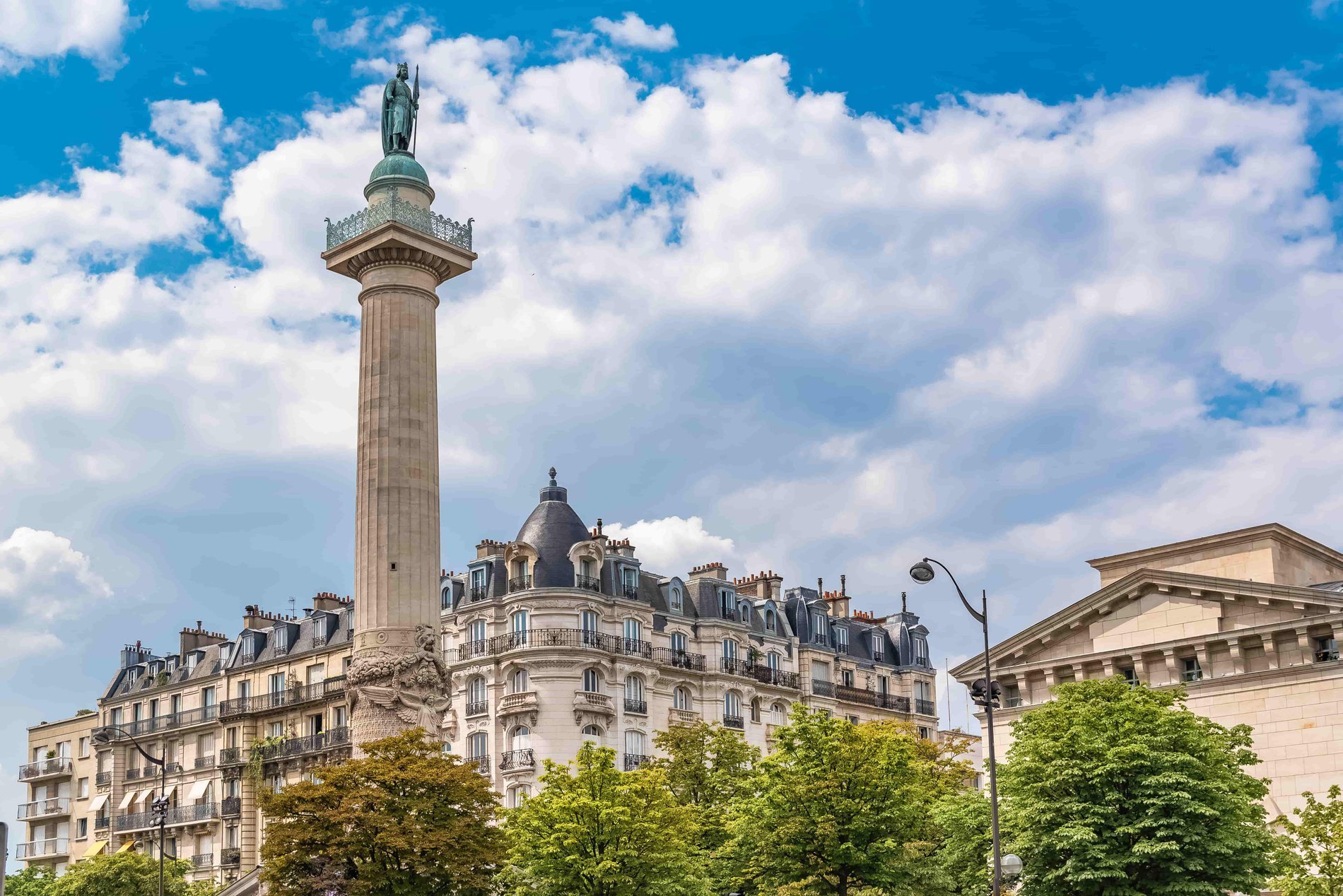
More than a century later, in 1787, architect and urban planner Claude-Nicolas Ledoux had two columns erected that still frame the entrance to the Cours de Vincennes and the former tollgate today. The statues of Philip Augustus and Saint Louis that crown them were not added until 1845, nearly sixty years later. Napoleon III, in turn, attempted to have a triumphal arch built on this square, with no more success than his predecessors.
Culture
The Triumph of the Republic, the square’s iconic sculpture
In the center of Place de la Nation stands a major work of 19th-century French sculpture: The Triumph of the Republic, commissioned from the sculptor Aimé-Jules Dalou.
Commissioned in 1879 by the City of Paris, this bronze group took nearly twenty years to complete. It was first unveiled in 1889 as a painted plaster version created for the centennial of the French Revolution, then unveiled in its final bronze form ten years later.
The work depicts the Republic standing on a chariot pulled by two lions, surrounded by allegorical figures: the Spirit of Liberty, a blacksmith symbolizing Labor, Justice, and Abundance, depicted as sowing the fruits of prosperity. Children complete the composition, adding a lively touch to this sculptural ensemble rich in republican symbols.
Fun Facts
Place de la Nation Today: A Space Redesigned for Pedestrians
Under the leadership of the Paris City Hall, Place de la Nation has undergone a profound transformation in recent years, gaining more green spaces and becoming a more welcoming place.
As part of a redevelopment program led by the City of Paris, seven major squares in the capital have been redesigned, including Place de la Nation. Long considered more of a roundabout than a true public space, it has been redesigned to prioritize pedestrians and cyclists at the expense of vehicular traffic.
The central island has thus been expanded to include grass and about fifty newly planted trees, which provide shade and a cool atmosphere for passersby. Several major thoroughfares radiate from this square, a true Parisian crossroads: Avenue du Trône, Boulevard Diderot, Boulevard Voltaire, and Avenue du Faubourg Saint-Antoine. Four metro lines and one RER line serve the area, supplemented by numerous bus routes, making it one of the capital’s most important transportation hubs.
Another legacy of its past: the Foire du Trône, the oldest French carnival and the largest in Europe, takes its name from the former Place du Trône. Established as early as 957 at the Abbey of Saint-Antoine—which no longer exists—it has been held since 1965 on the Pelouse de Reuilly, near the square whose name it still bears.
Practical Tips
What to See and Do Around Place de la Nation?
Beyond its own historical sites, Place de la Nation is an excellent starting point for exploring several must-see attractions in eastern Paris.
The famous Père Lachaise Cemetery is just a few minutes away, offering a peaceful stroll through one of the world’s most beautiful landscaped cemeteries, rich in historic gravesites. In the opposite direction, the Bois de Vincennes stretches out with its zoo, lakes, and expansive green spaces—ideal for a nature break right in the heart of Paris.
The Place de la Bastille, also accessible from the 9Hotel Bastille-Lyon, is just a few hundred meters from the Place de la Nation, making it easy to combine a visit to both sites in a single outing. With its blend of history, nature, and neighborhood life, the area around the Place de la Nation is perfect for both a leisurely stroll and a more active day of exploration.
Frequently Asked Questions
Everything you need to know before you go
How far is the 9Hotel Bastille-Lyon from Place de la Nation?
It’s about a 32-minute walk from the hotel, or just a 13-minute metro ride on Line 1 between the Gare de Lyon and Nation stations.What sculpture adorns Place de la Nation?
The square is adorned with the Triumph of the Republic, a monumental bronze sculpture by Aimé-Jules Dalou, depicting the Republic on a chariot pulled by two lions, surrounded by allegorical figures.Why is the square called “Place de la Nation”?
It has had several names throughout history, first Place du Trône, then Place du Trône-Renversé during the Revolution, before becoming Place de la Nation on July 14, 1880, under the Third Republic.What’s there to do near Place de la Nation?
Père Lachaise Cemetery, the Bois de Vincennes with its zoo, and the nearby Place de la Bastille offer great options for walks around the square.How do you get to Place de la Nation by public transportation?
The square is served by four metro lines, one RER line, and numerous bus routes, making it one of the most accessible transportation hubs in Paris.
Some of the images used have been edited using artificial intelligence.