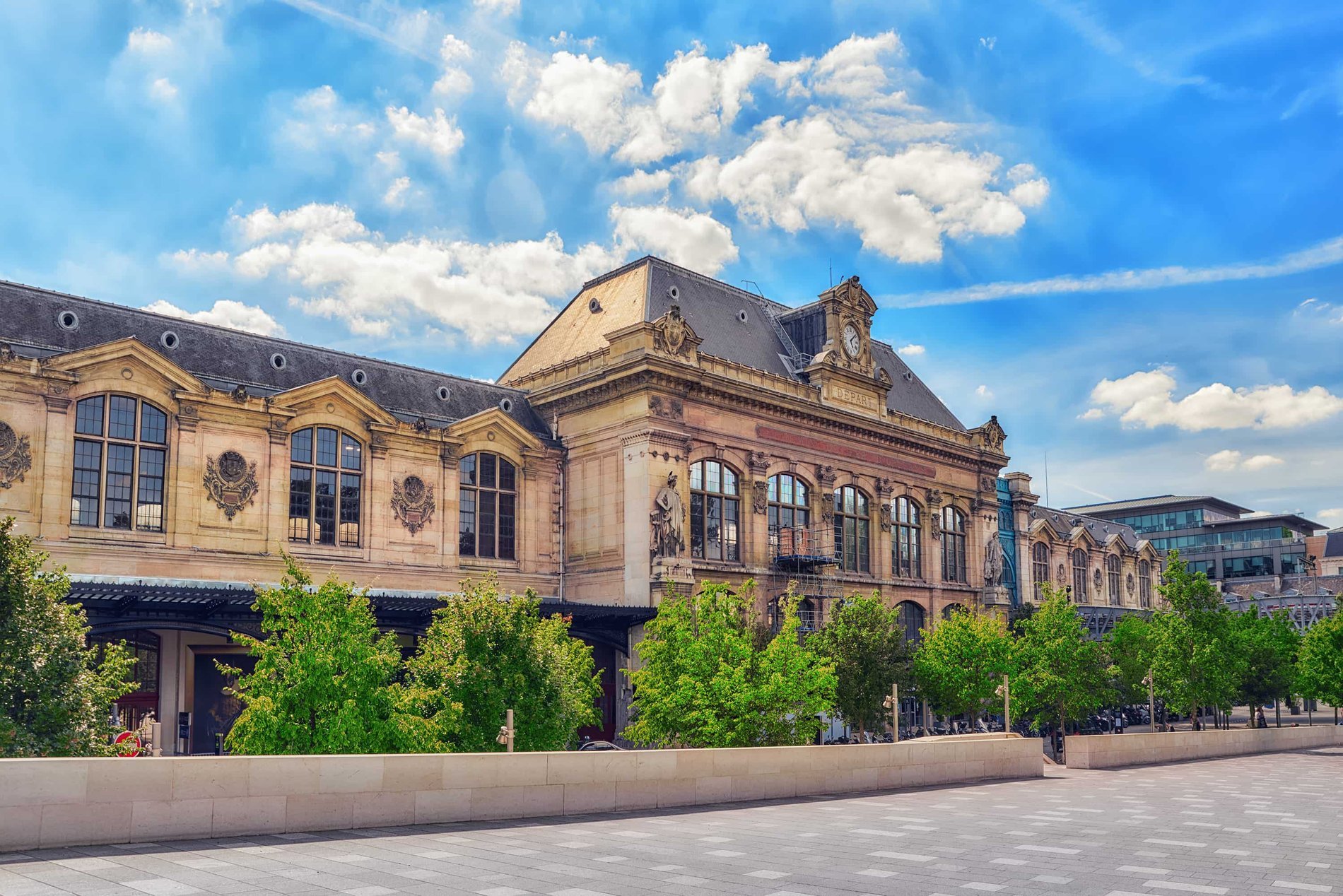
Just a 10-minute walk from the hotel
Gare d'Austerlitz
Location & Comfort
9Hotel Bastille-Lyon: Your Ideal Hotel Near the Gare d'Austerlitz
Located at 23 Rue de Lyon in the 12th arrondissement, the 9Hotel Bastille-Lyon is just a 14-minute walk from the Gare d'Austerlitz, across the Seine. This ideal location is perfect for travelers connecting to destinations in the Southwest or the Loire Valley, who can enjoy the hotel’s quiet rooms, welcoming lobby, and collaborative library before or after their journey.
The 9Hotel Bastille-Lyon was designed to cater to both business travelers and visitors passing through between two Parisian train stations. To reach Gare d’Austerlitz, guests have two options: a 14-minute walk across the Pont d’Austerlitz over the Seine, or a 10-minute metro ride on Line 5 from the Quai de la Rapée station to the Gare d’Austerlitz station.
Thanks to its location between Gare de Lyon and Gare d’Austerlitz, the hotel serves as a convenient base for any business trip, featuring a coworking desk and a lobby ideal for work or informal gatherings. The front desk team, available throughout your stay, is ready to recommend the best route based on train schedules, connections to plan for, or nearby neighborhoods to explore.
Back at the hotel, guests are greeted by a soothing atmosphere, combining the charm of the lobby with the welcoming ambiance of the shared library, where books are passed from one traveler to the next.
Rooms
Industrial-loft-style rooms near the Austerlitz Train Station
To extend your journey, the 9Hotel Bastille-Lyon offers 48 rooms in a completely peaceful setting, designed as true havens of comfort for travelers in transit or on extended stays.
Combining the warmth of a large wooden headboard with the elegance of sleek, graphic black lines—seen in the designer pendant lights and minimalist shelves—each room features a refined, contemporary decor. You’ll enjoy top-notch amenities: high-quality bedding, adjustable air conditioning, a functional work area, and free Wi-Fi.
Choose the perfect base from our various room categories:
- Single Room: A functional retreat measuring 10 to 12 m² with a view of the inner courtyard, perfect for a solo getaway.
- Classic Room: A welcoming and cozy living space measuring 11 to 15 m² for two people, ideal for a stopover in Paris.
- Classic Twin Room: A comfortable room measuring 10 to 14 m² with twin beds, perfectly suited for a trip for two.
- Superior Room: Our most spacious accommodation (12 to 16 m²), cleverly designed to ensure a relaxing stay.
History
A historic train station named in honor of Napoleon
Behind its imposing metal hall lies a turbulent history, from its inception as the Gare d'Orléans to its renaming in honor of one of Napoleon Bonaparte's most famous military victories.
Built in 1840 on the left bank of the Seine, across from the Jardin des Plantes and next to the Pitié-Salpêtrière Hospital, the station was originally named Gare d'Orléans, in reference to the railroad company that operated it. At the time, it served lines to the Southwest and Occitanie, facilitating economic exchanges between Paris and those regions. It was not until 1933 that it took the name Gare d’Austerlitz, commemorating Napoleon’s victory in 1814.
Its large, 280-meter-long metal hall, reminiscent of the architecture of the Eiffel Tower, is the second-largest in France after that of the Bordeaux-Saint-Jean station.
Gare d’Austerlitz was also the first Parisian station to feature an underground structure dedicated to commuter trains, and, like Gare de Lyon, it has been designated a Historic Monument. Through successive renovations, it has successfully balanced heritage preservation with infrastructure modernization, improving the passenger experience, traffic flow, and passenger comfort, all while preserving the spirit of this historic site.
Natural Heritage
The Jardin des Plantes and the Pitié-Salpêtrière, right outside the station
Upon exiting the Gare d'Austerlitz, travelers immediately find themselves facing two iconic Parisian institutions: the capital’s largest botanical garden and France’s largest hospital complex.
On Boulevard de l'Hôpital, which runs alongside the train station exit, stands the imposing Pitié-Salpêtrière Hospital. Louis XIV commissioned architect Libéral Bruant to build it on the site of a former arsenal where gunpowder was manufactured, hence its nickname, derived from saltpeter. Originally intended for the poor and later used as a prison, the hospital became the world’s largest hospice on the eve of the Revolution, with a capacity of 10,000 people; today, it remains France’s leading university hospital group.
Directly across from it, the Jardin des Plantes, established by royal decree in 1626 as a garden for medicinal plants, was directed in the 18th century by the naturalist Buffon before taking its current name during the Revolution. It is home to the National Museum of Natural History and its famous Gallery of Evolution, renowned for its dinosaur skeletons, as well as five large metal greenhouses dedicated to tropical and desert flora. Its menagerie, established in 1793, is the second-oldest zoo in the world and is still home today to more than a thousand animals, as well as a vivarium. In the past, the underground Bièvre River flowed south of this garden, which has now become one of the most popular green spaces in the 5th arrondissement.
Culture
From the Jardin des Plantes to the Panthéon: A Stroll Through the Latin Quarter
Continuing the stroll beyond the Jardin des Plantes toward Montagne Sainte-Geneviève, you’ll come across an Andalusian-style mosque, Gallo-Roman ruins, and one of Paris’s most iconic monuments.
Commissioned in 1879 by the City of Paris, this bronze group took nearly twenty years to complete. It was first unveiled in 1889 as a painted plaster version created for the centennial of the French Revolution, then unveiled in its final bronze form ten years later.
The work depicts the Republic standing on a chariot pulled by two lions, surrounded by allegorical figures: the Spirit of Liberty, a blacksmith symbolizing Labor, Justice, and Abundance, depicted as sowing the fruits of prosperity. Children complete the composition, adding a lively touch to this sculptural ensemble rich in republican symbols.
Practical Tips
Where Does the Austerlitz Train Station Lead? All Destinations from Paris
A historic gateway to the Southwest, the Gare d'Austerlitz remains a strategic hub for travel to the Val de Loire, Occitanie, and beyond, via a network of Intercités and TER lines and TGV connections.
Since its inauguration in the 19th century, the Gare d'Austerlitz has served as a prime gateway to regions rich in history, such as the Val de Loire and Auvergne. Today, it continues to play a vital role thanks to Intercités and TER services, which serve historic cities like Orléans, Tours, and Blois, as well as modern metropolises such as Toulouse, Montpellier, and Bordeaux. Connections to the TGV also allow for quick access to the major economic centers of southern France as well as tourist destinations along the Mediterranean coast.
The station is also seamlessly integrated into the Paris transit network: its connections to the RER—which leads to destinations such as the Champ de Mars, the Eiffel Tower, and the Palace of Versailles—and to the metro offer great flexibility for reaching other stations and neighborhoods throughout the capital. Much more than just a transit hub, the Gare d’Austerlitz remains a strategic crossroads between Paris and the southern regions, contributing daily to the country’s economic and cultural vitality.
Frequently Asked Questions
Everything you need to know before you go
How far is the 9Hotel Bastille-Lyon from Gare d'Austerlitz?
It’s about a 14-minute walk across the Pont d’Austerlitz, or a 10-minute metro ride on Line 5 from the Quai de la Rapée station to the Gare d’Austerlitz station.How far is Gare de Lyon from Gare d’Austerlitz?
The two stations are about 2 km apart and can be easily reached on foot in about 20 minutes along the Seine, or in a few minutes by metro on Line 5.What destinations are served from Gare d’Austerlitz?
The station primarily serves the Southwest and the Val de Loire via Intercités and TER lines, with cities such as Orléans, Tours, Blois, Toulouse, Montpellier, and Bordeaux, as well as TGV connections to the Mediterranean coast.What is there to see right near Gare d'Austerlitz?
Directly across from the station are the Jardin des Plantes, the National Museum of Natural History, and the menagerie, as well as the historic Pitié-Salpêtrière Hospital.Can you walk to the Latin Quarter from the station?
Yes, by crossing the Jardin des Plantes and then heading up toward Montagne Sainte-Geneviève, you can walk to the Grand Mosque of Paris, the Arènes de Lutèce, and the Panthéon.
Some of the images used have been edited using artificial intelligence.